
Physics meets common sense
Every mechanical engineer has faced those curious questions from non-engineers: “Why do planes fly so high?” The short answer is because 30,000 ft is the paradise flight: not too high, and not too low, just about right. It’s where the laws of thermodynamics, fluid dynamics and economics all shake hands politely. Commercial aircraft such as Boeing 777X and Airbus A350 cruise comfortably between 30,000 and 40,000 ft. At these altitudes, the air is thin enough to reduce drag but still sufficient for the engine to breathe and produce effective thrust. Think of it as the sweep spot of the sky, where engineers have optimized every equation to make flying profitable, safe, and surprisingly elegant. Of course, engineers don’t like to admit that it’s also the altitude where passengers are least likely to notice how small their legroom is.
Less air, more efficiency
At sea level, air is dense. About 1.2 kg/m3. Great for breathing, but terrible for drag. As an aircraft climbs higher, air density decreases exponentially, meaning there’s less resistance for the wings to slice through. That translates to lower parasite drag, which improves fuel efficiency. The Boeing 787 Dreamliner, for instance, typically cruises around 35,000–40,000 ft, where drag is about 80% lower than at ground level. This efficiency allows aircraft to burn less fuel and extend their range. This is crucial when flying from Kuala Lumpur to Heathrow with 200 passengers, none of whom are willing to pay extra for excess baggage. Engineers like to think of altitude as their version of vanishing point for drag – the higher we go, the more efficient the system becomes, until physics or nature tells us to stop showing off.
The air is thin, but not too thin
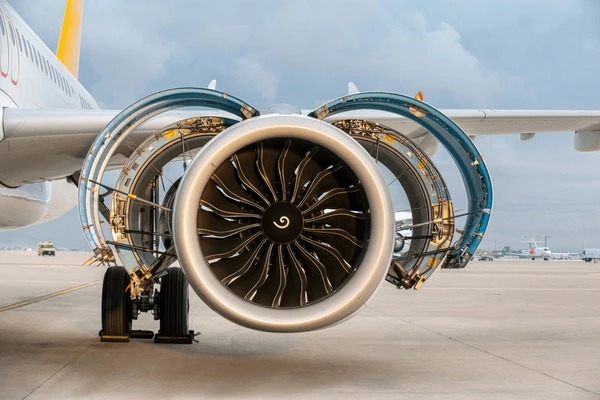
There is a reason planes don’t cruise at 60,000 ft., except for a very specific-purpose aircraft. Gas turbine engines, brilliant as they are, need oxygen to burn fuel in the combustion process. The higher you go, the less oxygen there is, and the harder the engines must work to maintain thrust. For humans, 10,000 is as far as we can go. Any higher, we shall see stars appearing right in front of our eyes. Most modern turbofan engines, such as the GE9X and Trent-XWB, are designed to perform optimally at altitudes between 30,000 and 40,000 ft. At that altitude, the balance between oxygen availability, fuel efficiency and thrust output is almost perfect. Too low and drag increases dramatically. Too high, and engines start gasping for air, and like our wallet at the end of the month.
The temperature advantage
The troposphere, which extends up to roughly 36,000 ft., features a steady drop in temperature, about a 2 °C drop for every 1000 ft gained, the lapse rate. At cruising altitude, temperatures often drop to -40 °C, which sounds extreme but is a blessing for jet engines. Cooler air means better compressor performance and reduces thermal stress on the turbine blades. In essence, the engines are “cooled-headed” at high altitudes, producing more thrust per kilogram of fuel than they would in the scorching air near the ground.

Dr. HELMEY RAMDHANEY MOHD SAIAH
Senior Lecturer
Faculty of Mechanical Engineering
Universiti Teknologi Malaysia
Avoiding the weather
Weather plays a huge role in choosing cruise altitude. Most clouds and storms live below 25,000 ft., so flying higher keeps passengers and cabin crew happy. At around 30,000 ft., aircraft glide above most weather disturbances, experiencing smoother air and less structural stress. The Airbus A321neo, typically cruising at 33,000–37,000 ft., takes advantage of this to ensure consistent performance and passenger comfort. At these levels, there’s less turbulence and fewer atmospheric “speed-bumps”.
Pressurization: Keeping humans comfortable
Cabin pressurization systems are designed to simulate an altitude of 6,000 – 8,000 ft inside, even when the aircraft is cruising at 35,000 ft. This ensures a comfortable oxygen environment and prevents passengers from feeling like they are climbing Mount Kinabalu without training. However, a higher altitude means a greater pressure difference between the inside and outside of the aircraft, placing greater stress on the fuselage. Engineers carefully design simulated altitudes that balance this structural load with aerodynamics and economic performance. In other words, we fly high enough to save fuel, but not too high that the cabin turns into a pressurized soda can.
The sweet spot
When combining fuel efficiency, engine performance, passenger comfort, and structural safety, the result is a cruising band roughly between 30,000 and 40,000 ft., which pilots call the Flight Level (FL) band, FL300 to FL400. On the Kuala Lumpur to Tokyo route, for instance, a B787 might climb to 39,000 ft. after a few hours, once it has burned off enough fuel to become lighter. On a shorter Kuala Lumpur to Bangkok trip, an A321neo would settle near 33,000 ft. Every meter count, and every Newton of thrust is calculated with surgical precision. It’s that perfect balance of thermodynamics, aerodynamics and airline economics.
Above clouds and below satellites
So next time you are on a flight above 30,000 ft., remember: you’re not just cruising through thin air. You are flying inside a meticulously engineered compromise between physics and practicality. It’s a triumph of modern mechanical engineering: optimizing performance, managing extreme environments, and designing for both comfort and cost. The next time you look out your tiny airplane window and see the curves of the Earth, know that every Pascal, Kelvin, and Newton was carefully investigated. After all, at 30,000 ft., the air might be thin, but the engineering behind it is certainly not.
