Written by Ahamad Amirul Afhiq bin Ahamad
Edited by Nuratiqah Imani Binti Noordin
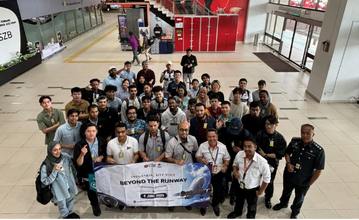
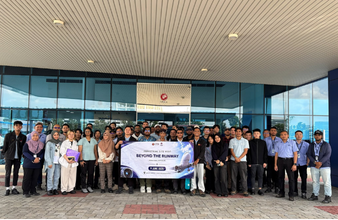
From the fast-paced environment of an active airport to the precision-driven world of aerospace manufacturing, third-year Aeronautics students experienced both sides of the aviation industry in one exciting industrial visit. On 9 June 2026, students from the Bachelor of Mechanical Engineering (Aeronautics) programme visited Sultan Abdul Aziz Shah Airport and Zenix Aerospace UPECA as part of the SEMT3822 Aviation Management course. The visit gave students a valuable opportunity to step beyond lectures and see how aviation systems operate in real professional environments.
At Sultan Abdul Aziz Shah Airport, students gained a closer look at what keeps airport operations running smoothly. They observed how aircraft movements, passenger flow, ground activities and operational coordination come together in a busy aviation setting.
For the students, it was a chance to connect what they learned in class with what happens behind the scenes. Concepts such as operational planning, safety, efficiency and coordination became much easier to understand when seen in action. The experience then shifted from airport operations to aerospace manufacturing at Zenix Aerospace UPECA.
Here, students entered a very different side of the aviation ecosystem — one built around precision, quality and consistency. They were introduced to aerospace manufacturing practices and learned why every component must meet strict technical requirements and international standards.
The visit also highlighted the importance of quality control, supply chain reliability and risk management. Students gained a clearer understanding of how manufacturing decisions can influence aircraft performance, operational reliability and the wider aerospace supply chain. What made the programme especially valuable was the opportunity to experience two connected but very different parts of aviation in a single visit.
At the airport, students saw how aviation operations are coordinated in real time. At the manufacturing facility, they discovered the level of engineering precision required before aerospace components ever reach an aircraft. Together, these experiences gave students a broader picture of how the aviation industry works as one interconnected ecosystem.
Beyond technical knowledge, the visit also exposed students to professional working environments and industry expectations. Seeing engineers, operators and technical teams at work helped them understand the importance of communication, teamwork, responsibility and attention to detail in the aviation sector. For aspiring aeronautical engineers, experiences like this can make classroom learning feel much more real.
FKM extends its appreciation to Malaysia Airports Holdings Berhad (MAHB) and Zenix Aerospace UPECA for their warm hospitality and valuable knowledge sharing. Through industry engagement and experiential learning, UTM continues to provide students with opportunities to explore the realities of engineering practice — helping them move from understanding aviation in the classroom to experiencing it where it truly happens.