Written by Dr. Mohd Rajali bin Jalal

Dr. Mohd Rajali bin Jalal
Senior Research Officer
Marine Technology Centre
Universiti Teknologi Malaysia
PROJECT TEAM | CONTRIBUTOR
Assoc. Prof Dr. Kang Hooi Siang
Assoc Prof Dr. Mohd Foad bin Abdul Hamid
A Malaysian container-terminal study shows why the smartest maintenance plan is not to maintain everything the same way.
WHEN ONE CRANE STOPS, THE PORT FEELS IT
At a busy container terminal, a quay crane does much more than lift boxes. It connects a ship to the entire landside cargo flow. When a critical crane system fails, vessel operations can slow, containers can queue, and delays can spread across the terminal. That makes maintenance more than a workshop issue; it becomes part of keeping the whole port moving.
The challenge is that a quay crane contains many systems, and they do not all carry the same risk. Treating every component with the same maintenance schedule wastes time and money while leaving the most important systems exposed. The research therefore asked a simple question: can real breakdown data tell us where maintenance effort matters most?
LET THE BREAKDOWN HISTORY SPEAK
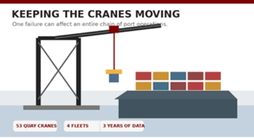
The study examined three years of breakdown records from 53 quay cranes across four fleets at a Malaysian container terminal. Instead of relying mainly on expert opinion, the team used the frequency, duration, and type of past failures to calculate how critical each major crane system was.
The team then combined the data using a Data-Driven Analytical Hierarchy Process (DD-AHP). In lay terms, it is a structured way of turning breakdown history into a priority list. The higher the score, the more attention a system deserves because its failure has a greater potential to disrupt operations.
ONE SYSTEM STOOD OUT CLEARLY
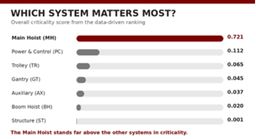
The ranking produced a clear result. The Main Hoist, which lifts and lowers containers, recorded an overall criticality score of 0.721. That was far above Power and Control (0.112) and the Trolley system (0.065). Gantry, Auxiliary, Boom Hoist, and Structure ranked lower.
This does not mean you can ignore the lower-ranked systems. It means their failures occur less often and have less operational impact. The ranking shows where limited maintenance resources, sensors, spare parts, and technical attention can make the biggest difference.
SMARTER MAINTENANCE MEANS DIFFERENT MAINTENANCE
Because the Main Hoist was classified as very high criticality, the study recommends predictive maintenance that uses condition data to detect problems before a breakdown occurs. Power and Control, ranked at medium criticality, is better suited to planned preventive work supported by condition monitoring.
Lower-criticality systems such as the Trolley, Gantry, Boom Hoist and Auxiliary systems can generally be managed with corrective maintenance and basic preventive care. Structure is a special case: although it ranked very low, cracks, fatigue, or corrosion cannot be allowed to run to failure safely, so periodic inspections and non-destructive testing remain essential.
FROM “FIX EVERYTHING” TO “FOCUS WHERE IT MATTERS”
The team also stress-tested the ranking using 10,000 Monte Carlo simulation runs, supporting the robustness of the maintenance priorities. The bigger lesson is straightforward: smarter maintenance is not about doing more work everywhere. It is about using evidence to decide what needs close monitoring, what needs routine care, and what can be repaired when necessary. For busy ports, that can mean using people, time, and money better while keeping the cranes and the cargo moving.
RESEARCH NOTE
This feature article is based on findings from the funded research project “Reliability, Availability, Maintainability Analysis and Maintenance Strategy for Container Port Handling Equipment” (Chargeline No. R.J130000.7.709.4J753). For further details, please refer to our published article: Jalal MR, Kader ASA, Hamid MFA, Kang HS. “A stochastic Petri Net-based approach for operational performance estimation of quay cranes.” Quality and Reliability Engineering International. 2023;39:1660–1680.